
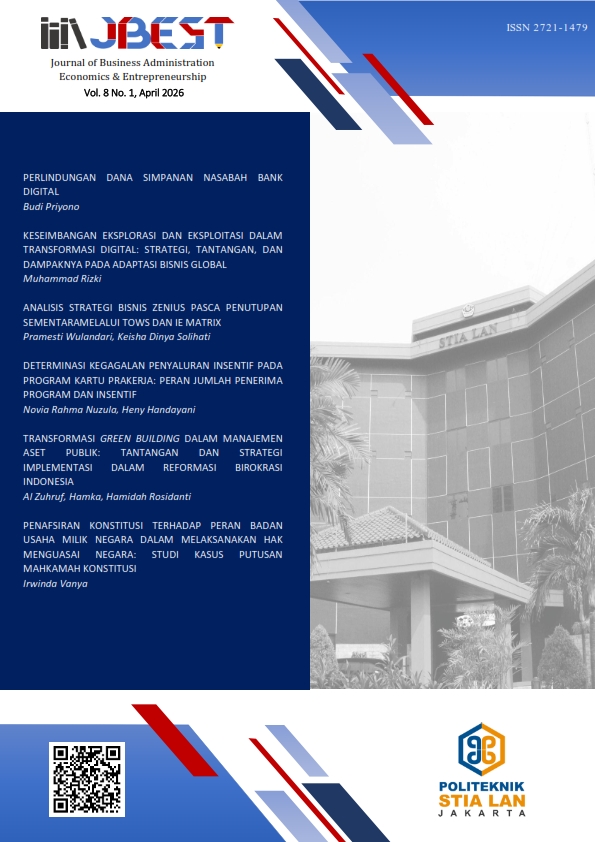
Keseimbangan Eksplorasi dan Eksploitasi dalam Transformasi Digital: Strategi, Tantangan, dan Dampaknya pada Adaptasi Bisnis Global
Article Sidebar
Main Article Content
Abstract
Kata Kunci: transformasi digital, inovasi teknologi, strategi bisnis, eksplorasi, eksploitasi, adaptasi bisnis global
Article Details

This work is licensed under a Creative Commons Attribution-ShareAlike 4.0 International License.
Authors who publish with this journal agree to the following terms:
- Authors retain copyright and grant the journal right of first publication with the work simultaneously licensed under a Creative Commons Attribution-ShareAlike 4.0 International License that allows others to share the work with an acknowledgement of the work's authorship and initial publication in this journal.
- Authors are able to enter into separate, additional contractual arrangements for the non-exclusive distribution of the journal's published version of the work (e.g., post it to an institutional repository or publish it in a book), with an acknowledgement of its initial publication in this journal.
- Authors are permitted and encouraged to post their work online (e.g., in institutional repositories or on their website) prior to and during the submission process, as it can lead to productive exchanges, as well as earlier and greater citation of published work.

JBEST is licensed under a Creative Commons Attribution-ShareAlike 4.0 International License.
References
Abrokwah-Larbi, K., & Awuku-Larbi, Y. (2024). The impact of artificial intelligence in marketing on the performance of business organizations: evidence from SMEs in an emerging economy. Journal of Entrepreneurship in Emerging Economies, 16(4), 1090-1117. https://doi.org/10.1108/JEEE-07-2022-0207.
Ahmed, I., Feng, B., Emmanuel Yeboah, K. et al. (2024). Leveraging Industry 4.0 for marketing strategies in the medical device industry of emerging economies. Sci Rep 14, 27664. https://doi.org/10.1038/s41598-024-78521-0.
Alexei, B. (2021). Global Oil & Gas Corporations in the Race for Technological Superiority. Mirovaya ekonomika i mezhdunarodnye otnosheniya, 65(5), 59-67. https://doi.org/10.20542/0131-2227-2021-65-5-59-67.
Etemad, H. (2023). The need for strategic redirection and business model change: The impact of evolving influential forces of change on international entrepreneurship environment. J Int Entrep 21, 441–463. https://doi.org/10.1007/s10843-024-00348-7.
Hossain, S., Hassan, S., & Karim, R. (2023). Assessment of critical barriers to Industry 4.0 adoption in manufacturing industries of Bangladesh: An ISM-based study. Brazilian Journal of Operations & Production Management, 20(3), 1797-1797. https://doi.org/10.14488/BJOPM.1797.2023.
Jaloliddin, R. (2023). Digitalization in global trade: opportunities and challenges for investment. Global Trade and Customs Journal, 18(10): 391 – 395. https://doi.org/10.54648/gtcj2023043.
Jiang, H., He, B., Mubarik, M. S., & Shi, S. (2024). Role of supply chain digitalization and global supply chain in decarbonization of natural resources sector supply chain. Journal of Environmental Management, 370, 122689. https://doi.org/10.1016/j.jenvman.2024.122689.
Lai, J. Y., Wang, J., & Cai, R. H. (2024). The effects of AIoT-SC strategic alignment on SC intelligence and NPD performance. Supply Chain Forum: An International Journal, 1–19. https://doi.org/10.1080/16258312.2024.2384824.
Matt, C., Hess, T., & Benlian, A. (2015). Digital Transformation Strategies. Business & Information Systems Engineering, 57 (5), 339–343. https://doi.org/10.1007/s12599-015-0401-5.
Miuccio, L., Panno, D., & Riolo, S. (2022). An energy-efficient DL-aided massive multiple access scheme for IoT scenarios in beyond 5G networks. IEEE Internet of Things Journal, 10(9), 7936-7959. https://doi.org/10.1109/JIOT.2022.3231128.
Monroy-Osorio, J. C. (2024). Charting the digital route to net-zero: a framework for sustainable industry practices. Cleaner Logistics and Supply Chain, 13, 100191. https://doi.org/10.1016/j.clscn.2024.100191.
O'Reilly III, C. A., & Tushman, M. L. (2013). Organizational ambidexterity: Past, present, and future. Academy of management Perspectives, 27(4), 324-338. https://doi.org/10.5465/amp.2013.0025.
Philo, K. G., & Webber-Youngman, R. C. W. (2024). A critical investigation into identifying key focus areas for the implementation of blockchain applications in the mining industry. Journal of the Southern African Institute of Mining and Metallurgy, 124(6), 319-330. https://doi.org/10.17159/2411-9717/2597/2024
Rajbhandari, S., Devkota, N., Khanal, G., Mahato, S., & Paudel, U. R. (2022). Assessing the industrial readiness for adoption of industry 4.0 in Nepal: A structural equation model analysis. Heliyon, 8(2). https://doi.org/10.1016/j.heliyon.2022.e08919.
Rehman, S. U., Alnazzawi, N., Ashraf, J., Iqbal, J., & Khan, S. (2022). Efficient top-K identical frequent itemsets mining without support threshold parameter from transactional datasets produced by IoT-based smart shopping carts. Sensors, 22(20), 8063. https://doi.org/10.3390/s22208063.
Reyes, P. M., Visich, J. K., & Jaska, P. (2020). Managing the Dynamics of New Technologies in the Global Supply Chain. IEEE Engineering Management Review, 48(1), 29–41. https://doi.org/10.1109/EMR.2020.2968889
Rogers, D. L. (2016). The digital transformation playbook: Rethink your business for the digital age. Columbia University Press. https://doi.org/10.7312/roge17544-007.
Sandner, P., Lange, A., & Schulden, P. (2020). The role of the CFO of an industrial company: an analysis of the impact of blockchain technology. Future Internet, 12(8), 128. https://doi.org/10.3390/fi12080128.
Su, J., Yao, S., & Liu, H. (2022). Data Governance Facilitate Digital Transformation of Oil and Gas Industry. Frontiers in Earth Science, 10:861091. https://doi.org/10.3389/feart.2022.861091.
Vial, G. (2021). Understanding digital transformation: A review and a research agenda. Managing digital transformation, 13-66. eBook ISBN9781003008637.
Volberda, H. W., Khanagha, S., Baden-Fuller, C., Mihalache, O. R., & Birkinshaw, J. (2021). Strategizing in a digital world: Overcoming cognitive barriers, reconfiguring routines and introducing new organizational forms. Long Range Planning, 54(5), 102110. https://doi.org/10.1016/j.lrp.2021.102110.
Wofford, L., Wyman, D., & Starr, C. W. (2020). Do you have a naïve forecasting model of the future?. Journal of Property Investment & Finance, 38(4), 267-269. https://doi.org/10.1108/JPIF-12-2019-0154.
Yang, X., Cao, D., Chen, J., Xiao, Z., & Daowd, A. (2020). AI and IoT-based collaborative business ecosystem: a case in Chinese fish farming industry. International Journal of Technology Management, 82(2), 151-171. https://doi.org/10.1504/IJTM.2020.107856.
Zheng, Y., Wang, Y., & Mian, S. A. (2025). Strategic positioning of projects in crowdfunding platforms: do advanced technology terms referencing, signaling and articulation matter?. International Journal of Entrepreneurial Behavior & Research, 31(2/3), 751-780. https://doi.org/10.1108/IJEBR-01-2022-0071.